
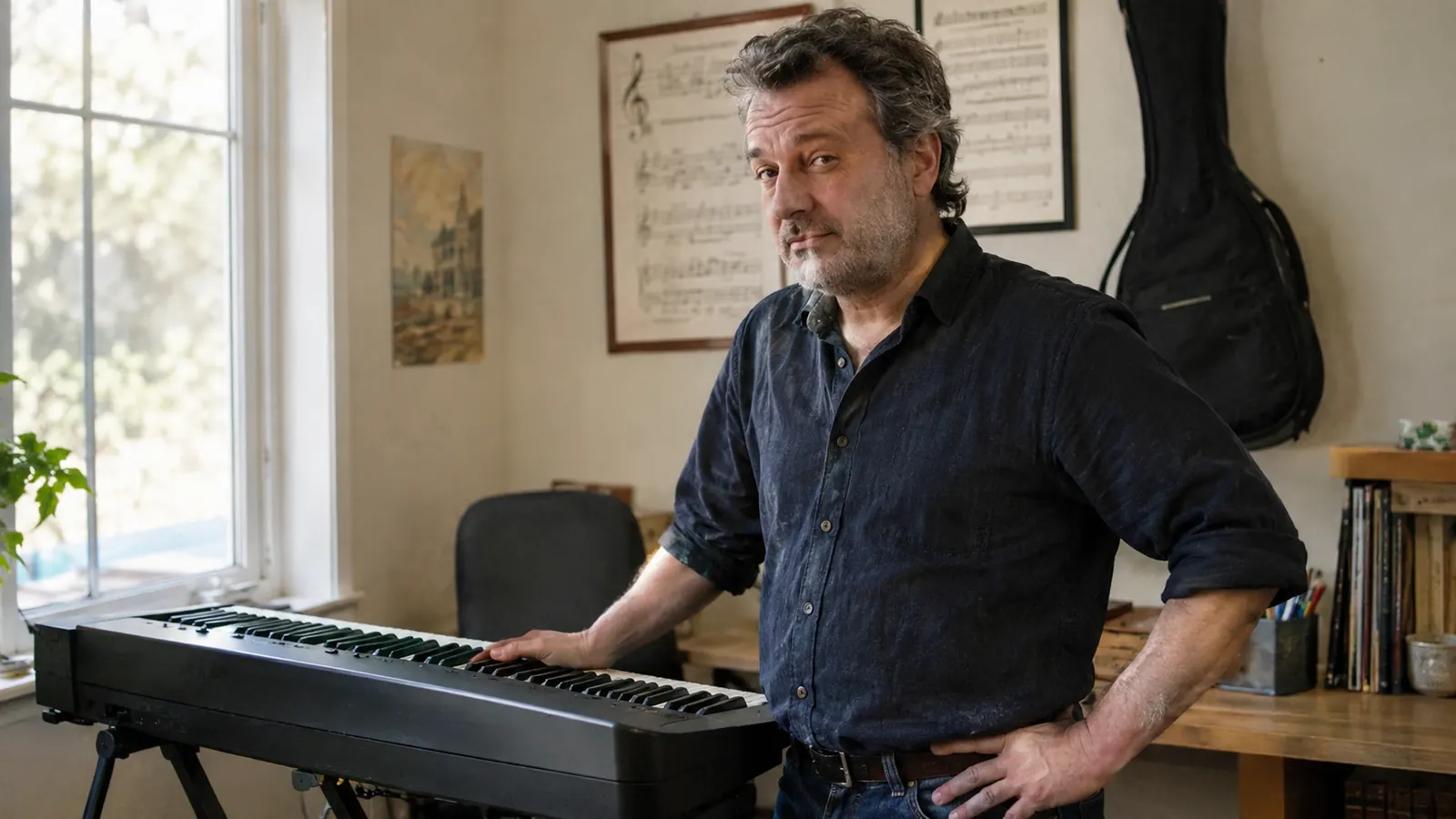
The Quick Verdict
The best-selling beginner 88-key for a reason: honest piano learning on a budget, once you accept the semi-weighted action, the modest speakers, and a volume knob that doubles as the voice selector.
Amazon Check Today's Price →Last September, a dad named Tom emailed me from his car outside his daughter's school. The Alesis Recital he'd bought for her tenth birthday kept changing sounds every time she turned the volume down, and by Tuesday he was convinced the keyboard was broken. It wasn't. He had pressed the Volume Pearl to lower the volume, and on this keyboard pressing the knob is what changes the voice instead. I get a version of that email a couple of times a year, and every time, it's the Recital.
That one quirk says more about this keyboard than any ad paragraph. The Alesis Recital is the most-recommended beginner 88-key in my studio and one of the best-selling digital pianos on Amazon, with an 11,000-plus review count and a 4.6 average. I still hand it to more first-year students than anything else I can buy for the money. And precisely because it's that popular, it deserves the honest review that marketing skips: the volume knob that confuses parents, the speaker ceiling, the cabinet that flexes, and the action that is lighter than it looks.
Read My Short Verdict Before You Add It to the Cart
I've taught on the Alesis Recital for over a year and recommended it to more families than any other keyboard. Check today's price on Amazon, then keep reading for the honest breakdown of what I'd warn a parent about.
Amazon Check Today's Price on Amazon →The First Lesson Parents Learn: How the Volume Pearl Works
The Volume Pearl is the single knob on the front left of the keyboard, and it does two jobs. Turn it and you get master volume. Press it and you cycle through the five built-in voices: the acoustic piano voice, an electric piano, an organ, a synth, and a bass. There is no marking on the panel that explains the press function, so the most common moment in any Recital household is a kid who wanted more volume and instead landed on the organ sound in the middle of a song. The fix is a three-second explanation, but nobody puts the explanation in the box.
The same design theme runs through the rest of the panel. Lesson Mode splits the 88 keys into two matching halves so a student and teacher can sit side by side playing the same notes, which is genuinely useful and rare at this price. But the mode buttons are just as unlabeled as the Volume Pearl, and the little indicator light shuts off after a while to save power, so parents think the keyboard powered down. I've had families write to me convinced the Recital was switching itself off in the middle of practice. It wasn't. The display was just settling into its idle state.
Here's what the Volume Pearl actually does well once you stop pressing it by accident: it's a smooth, quiet rotary control that feels better than the up-down buttons on many keyboards twice the price, and the LED ring around it makes the current voice obvious at a glance. The same panel hides a genuinely capable 128-note polyphony engine, which means a student can hold down the sustain pedal and stack notes without notes dropping out, something that trips up cheap keyboards constantly. The polyphony number sounds like marketing. The dropped notes it prevents are very real.
The panel hides one more feature that families discover late, and this one is pure upside. A dedicated metronome button sits on the front of the Recital, separate from the shared Volume Pearl, so a young player can set a steady beat without digging through a menu. There is also a record and playback function that lets a student lay down a phrase, then play along with the recording. I use both in nearly every first-year lesson: set the metronome to sixty, play the right hand, record it, then bring in the left hand over the playback. On a keyboard priced at the bottom of the market, that combination quietly does the work a practice partner would normally do.
What the Speakers Will and Won't Do
There are two ten-watt speakers built into the Recital, twenty watts total, and I put that number on the table up front because it sets expectations. In a child's bedroom, that's plenty loud. In a living room with the TV on, it's fighting a fair match. In a school hallway or against a real upright piano, it loses. The weakness shows up as distortion. Push the volume near the top and the bass voice gets woolly, the piano voice starts to break up, and the room starts to sound like a cheap Bluetooth speaker at max gain.
The honest fix is the headphone jack, and it's a good one. Plug in a pair and the Recital sounds noticeably better than its own speakers, because you stop pushing the little amp. For quiet practice, that makes it a genuinely good keyboard. And the piano voice itself is the star of the five. It's a sampled grand piano sound with a usable amount of character and a built-in reverb and chorus effect, and for a first year of note reading and hand position it's more than a beginner needs.
I'll also say something that sounds like I'm softening the review already: the electric piano voice is genuinely good, the kind of sound you'd happily use on a gig through a proper amp, and the organ and bass voices are usable novelty for a young player who wants to feel like they're on stage. The weakness is volume, not tone. If you keep the Recital at half master volume, which is plenty for a bedroom or a study, the sound stays clean and pleasant. The distortion only shows up when you ask the little amplifier to be a big one.
The Semi-Weighted Action, Minus the Marketing Words
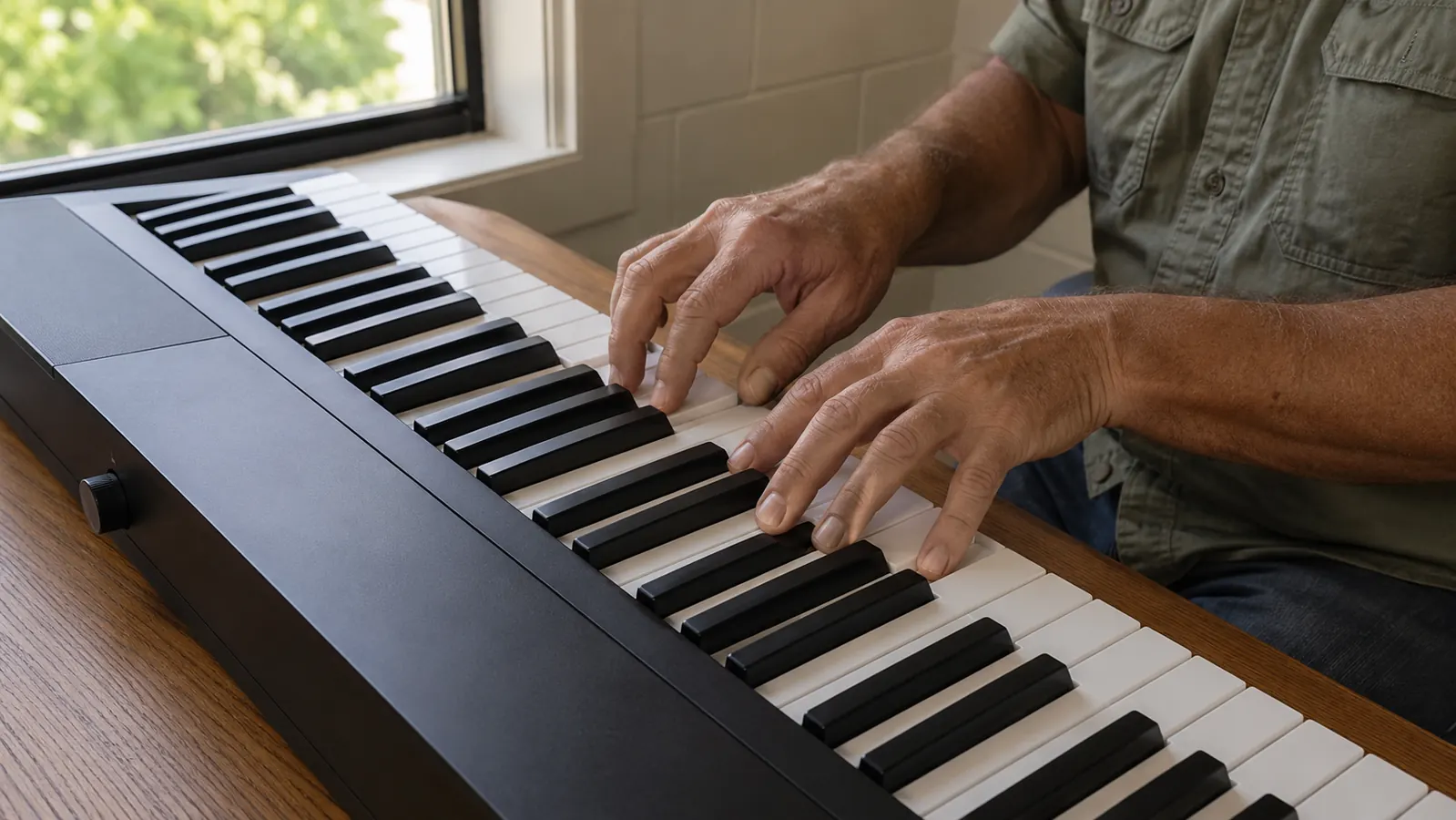
Semi-weighted means the keys are spring-loaded and can't quite decide whether they want to be a piano or a synth keyboard. They're heavier than the bare plastic keys on a toy keyboard, which is a real step up, and they bounce back fast enough to handle repeated notes. But they do not feel like a weighted hammer-action piano, and they never will. The marketing calls this an 88-key digital piano, and it is, in the sense that it has 88 piano-shaped keys. The feel is a compromise, and students can feel it.
Here's the teacher's honest take: for a child or an adult who is learning notes, rhythm, and hand position, the semi-weighted action is not a handicap. Every one of my first-year students develops good posture and good finger independence on the Recital before they ever touch a grand. But if the player already knows the basics and wants a piano touch to build real finger strength, this keyboard will eventually feel light, and they will outgrow it. That's a feature, not a failure. I explain exactly why the feel matters for beginners in my article on weighted keys for piano beginners.
There's one physical habit worth knowing before it surprises you in a quiet room. Releasing a semi-weighted key fast makes a light clack from inside the cabinet, and in a silent house at nine at night it's audible to someone in the next room. It's not a defect, and it doesn't affect the sound through headphones. But a parent who expects a hushed acoustic piano will notice the mechanical chatter on the first evening, so I mention it in every studio conversation about this keyboard.
The Cabinet, the Pedal, and the Extras You'll Buy Afterward
The Recital weighs around fourteen pounds and the cabinet is molded plastic, which is exactly the trade you'd expect at this price. It's light, it's affordable, and it flexes if you pick it up by the sides while holding the keys. The included sheet music stand is flimsy and slides under the weight of a real method book, and the sustain pedal that ships in the box is a simple plastic switch that skids across a wood floor. None of these are dealbreakers. All of them are things a parent discovers on day two, after the reviews stopped talking.
Plan on two extras and you'll be fine. A proper folding X-stand gives the keyboard a steadier home than the table it often lands on, and a heavier pedal or a strip of rug tape keeps the sustain from migrating mid-song. One more quiet surprise: the Recital connects to a computer for lessons and software through a USB-MIDI port, but the cable is not in the box. It's a cheap cable, but it's an extra trip to the store at nine at night, which is when everyone needs it. My guide to setting up a practice corner at home covers the stand, the bench, and how to place the whole setup so it actually gets used.
Whatever I say about flex, I should also say what fourteen pounds gets you: a real 88-key instrument you can carry under one arm from the bedroom to the dining room for Sunday dinner, toss into the back of a hatchback for a lesson, or stand up on a folding table at a school concert in under two minutes. None of my three Recitals has ever failed. The one that lives in my studio has been bumped, tilted, and hauled for a full year, and it still reads every key press the day it arrived.
Where the Recital Still Wins at This Price
All of the above is why this review needed writing, and none of it changes the reason the Recital is my default answer when a parent asks what to buy. It has 88 real keys, which means the student's hands learn real geography instead of the abbreviated keyboard of a 61-key toy. It has Lesson Mode, which turns a single keyboard into two matching halves so I can sit next to a first grader and play the same notes she plays. And the price is the bottom of the market, which matters for the families I teach more than it matters to any gear reviewer.
Add what's in the box and it borders on exceptional value. Three months of Skoove online lessons and sixty free Melodics lesson packs ride along, which turns the Recital into a complete first-year starter kit for a household with no teacher nearby. That's the part of the honest review that reads like a compliment, because it is one. The Recital gives a beginner more of a head start than anything else I can name at this price, and the quirks I've spent this review naming are the price of admission.
The comparison nuance parents actually need is this. A hammer-action keyboard will feel more like a real piano on day one, but it will not teach note reading faster, it will not make a six-year-old practice longer, and it will not build hand position on its own. The things that decide whether a first-year student keeps playing are the things the Recital does best: enough keys, a piano voice that pleases the ear, a metronome and Lesson Mode that structure the practice, and a price that did not gut the family budget. The heavier action is a later lesson, best learned when finger strength is already there to use it.
I have to add one honest footnote to that praise, and it's the hidden cost I mentioned earlier. The Recital gets a family through the first year on its own, but a stand and a bench push the total setup past the price of the keyboard itself once you add them. My long-term review of the Recital, written after a full year of weekly lessons, goes line by line through what a year of practice on this keyboard actually costs, between the keyboard, the stand, the bench, and the accessories. Read that one before you set a budget, because the keyboard is only the first line item.
What I Liked
- The least expensive 88-key I'd put in a beginner's hands, and it doesn't feel like a toy
- A piano voice with 128-note polyphony, reverb, and chorus that outplays its category
- Lesson Mode splits the keyboard in half so student and teacher can play together
- Around fourteen pounds, light enough to carry to a lesson or a family dinner
- Headphone practice sounds genuinely good through the same speakers that distort at top volume
Where It Falls Short
- The Volume Pearl doubles as the voice selector, and the unlabeled button confuses everyone at first
- The built-in speakers distort near the top of their range
- The plastic cabinet flexes and the included music rest is flimsy
- The semi-weighted action feels light next to a hammer-action piano
- No stand, no bench, and no USB cable in the box, so the full setup costs extra
In a year of lessons, exactly one student has ever asked me to turn the built-in speakers all the way up, and she took it back after the first bass note.
Who This Is For
Buy the Alesis Recital for a first-year student, a child aged six to twelve starting lessons, an adult who wants to prove to themselves that they'll keep at it, or a household on a budget that still wants a real 88-key instrument rather than a 61-key toy. It's the keyboard I've recommended to more families than any other, and it's the instrument behind one of my favorite studio stories, about an adult student who started over at fifty-two and practiced every single day. I tell that story in my other reviews, and it is the reason I reach for the Recital before I reach for anything else in the price range.
If you are wondering what a first lesson on the Recital actually looks like, here it is. We find middle C by feel, settle the right thumb on it, and spend fifteen quiet minutes on a five-note scale with the metronome clicking in the background. The keyboard sits on an ordinary table, the headphones keep the room peaceful, and the student is never fighting the instrument. That last part is the real job of a first keyboard. A beginner should be spending their energy on listening and shaping the notes, not on wrestling a stiff action or a wheezy speaker.
Who Should Skip It
Skip it if the student already plays and wants a closer-to-real piano feel, if the household needs to fill a room with sound at a genuine piano volume, or if the buyer keeps saying they'll upgrade anyway. For those cases the extra money buys real hammer action and a better amplifier, and my side-by-side comparison of the Recital against the Yamaha P-45 is exactly the breakdown of what the difference sounds and feels like. The Recital is not a bad piano. It is a beginner piano that knows it's a beginner piano, and the people who should skip it are the ones who are already past the beginner stage.
So here's the trade in one sentence: the Alesis Recital asks you to accept light keys, modest speakers, and a few unlabeled buttons, and in exchange it gives a first-year student the most complete, most forgiving 88-key start anywhere near its price. I keep recommending it because the trade is a fair one, and I keep writing honest reviews like this one because the trade deserves to be named. If the student in your house is ready to start, this is where I'd start them.
Quirks and All, It's Still the Start I'd Recommend
The trade is a fair one for a first-year student. Check today's price on Amazon, and read my long-term review of the Recital before you set your budget.
Amazon Check Today's Price on Amazon →