
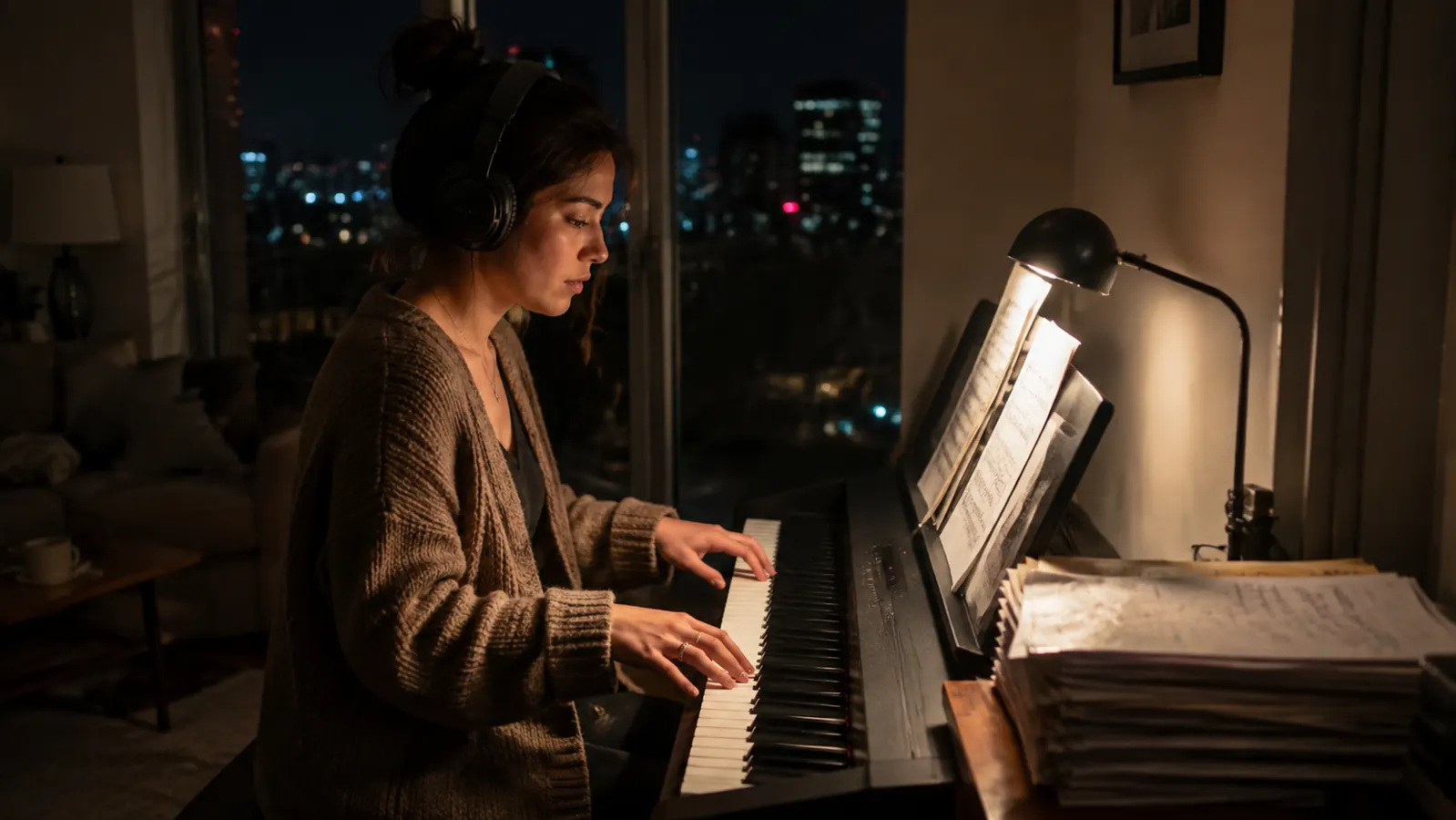
Margaret taught English at a high school across town, graded essays for a testing service two nights a week, and had exactly one hour a day that belonged to her. It started at midnight, which was when the retired couple in the apartment below hers had been asleep for hours. She had wanted to learn piano since she was a girl. She had simply never owned an hour in which to do it.
At her first lesson she sat down like a student carrying a confession. A year earlier she had bought an entry-level 88-key digital piano, parked it against a shared wall in her one-bedroom apartment, and never touched it again. Every time she thought about playing, she could hear the couple downstairs breathing through the floor. She had tried the workarounds too: a keyboard app on her phone with the volume down, a silent piano that taught her to play the air, and a pair of earbuds in the headphone jack that leaked sound and hurt after twenty minutes.
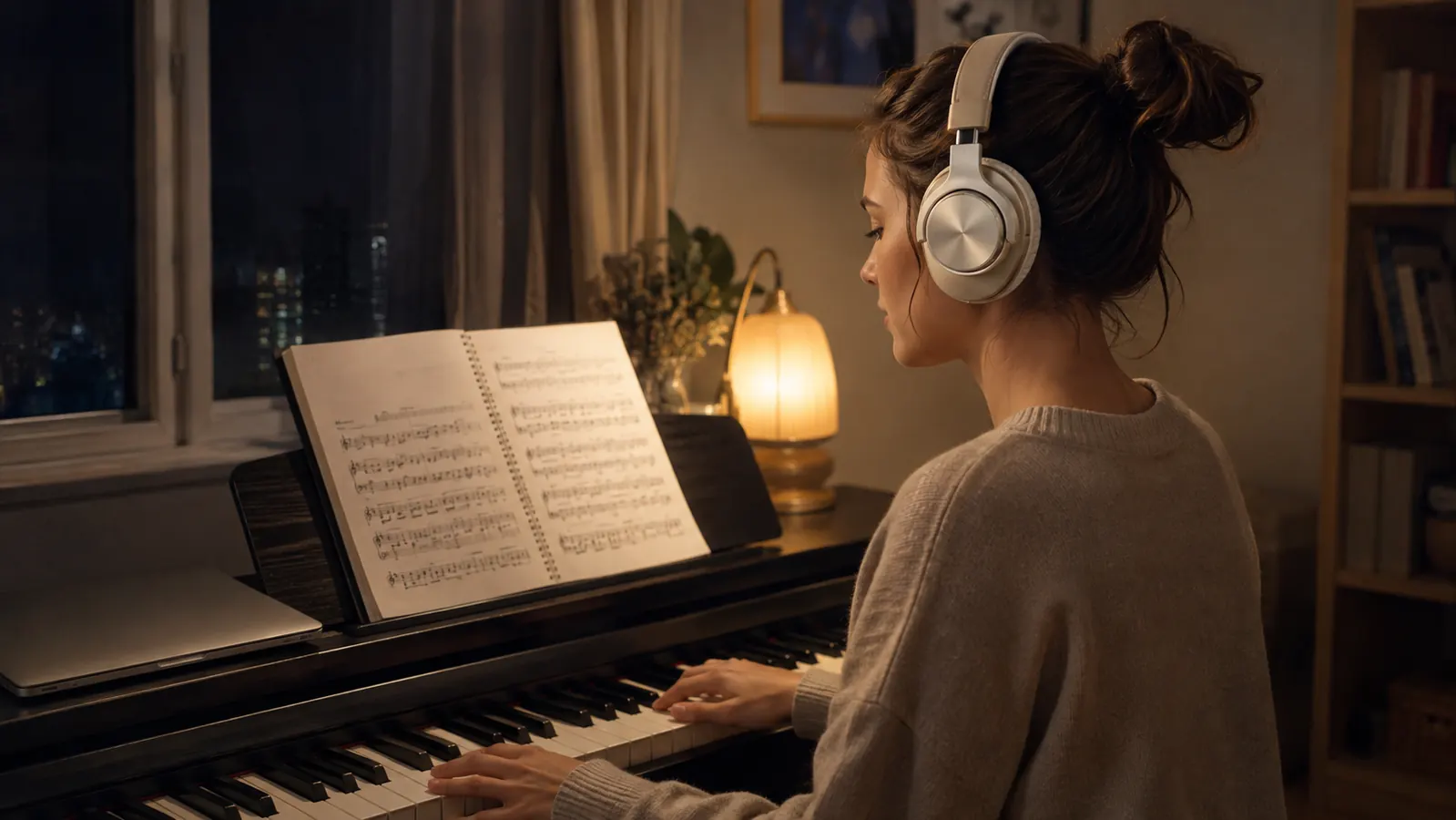
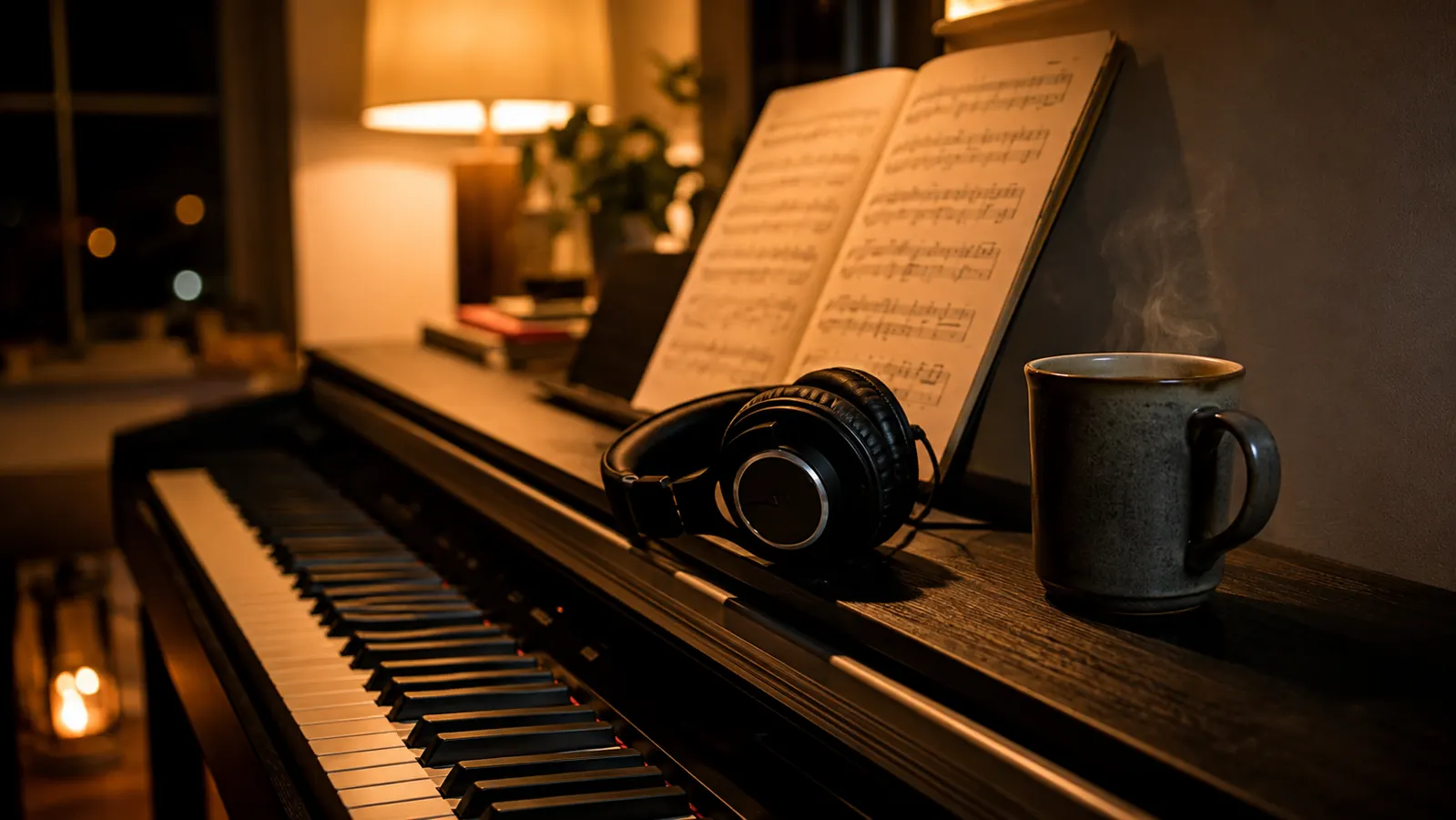
I told her the opposite of what she came for, reached into the drawer, and handed her the Audio-Technica ATH-M20x I keep there for students, the same closed-back monitor headphones that sit on my desk at home. Every digital piano and keyboard built in the last decade has a headphone jack, I said, and a sealed pair of cans turns that jack into a full practice room, whether the rest of the world is awake or not. She looked at them like I had handed her contraband.
We walked over to a keyboard, I plugged the cable in, and I asked her to play the C scale at a volume that would have carried across the street in daylight. She played two notes and stopped. When she turned around, her eyes said it before her mouth did. The whole piano was in her ears, left hand and right hand, the sustain pedal, the weight of every key, and not one note of it was reaching the floor below. That is what closed-back means, sound built to stay sealed in the cups, made for exactly one pair of ears and nobody else's.
From that night on she practiced at midnight, at full volume, on a piano that had gone silent for a year. The retired couple below her never heard a single note. Three months in she sent me a voice memo recorded at half past twelve, some piece she had worked up with both hands moving properly and the pedal doing its job, and it sounded like a real session from somebody's studio. She asked if she could keep the pair. I told her the drawer had more.
Margaret practiced at full volume, at midnight, for three months straight, and the retired couple in the apartment below never heard one note.
You Have an Hour Nobody Interrupts. Don't Waste It.
Whatever quiet hour you get, a sealed pair of closed-back monitor headphones turns it into a full practice room. This is the pair I hand students first.
Amazon Check Today's Price on Amazon →The part that matters, and it is never really the gear, is what the quiet hour does to a habit. Margaret stopped practicing because she could not, then started practicing because she wanted to. That switch took about four weeks, and it showed up in her playing first. She also stopped apologizing for the hour. Guilt is the heaviest mute pedal in music, and a sealed pair of headphones lifts it.
Ninety days in, she played a short piece for her department at a staff meeting, the first time in her life she had played for anybody. She told me afterward that the piano sounded the same in the daylight as it had at midnight, which I took as a real compliment, because it meant the sound in her ears had become the sound she trusted. That trust is the entire job of a monitor headphone. It does not flatter what you play. It tells you the truth so you can fix it, and you can only fix what you can hear clearly.
For honesty, here is the part a sales page would soften. The M20x is the budget step of the Audio-Technica studio line. The midrange is a little scooped, the plastic build will not survive a daily drop off a music stand, and the earpads are not plush. None of that matters for the midnight job. What matters is that the cups seal, that a student can wear them through a forty-five minute lesson without aching ears, and that the cable reaches from the keyboard to a person sitting where people actually sit. I buy these in threes, and I have for years.
It is also the pair I hand to my youngest students, because the fastest way to help a seven-year-old focus is to close off the rest of the room. I keep an Audio-Technica M20x in every teaching room I own. Some sounds are only yours when the world is shut out. That turns out to be true at seven in the afternoon, and it turns out to be true at midnight too.
What I'd Tell You If We Were Sitting at My Kitchen Table
If you and I were sitting at my kitchen table right now, coffee gone cold and the dishes long done, here is what I would tell you. You do not need a soundproofed room. You do not need a louder instrument. And you do not need permission from a single neighbor to practice. You need three things: a keyboard with a headphone jack, a sealed pair of closed-back monitor headphones, and one hour that belongs only to you. If that hour is midnight, take it, and hold it, and stop apologizing for it. More musicians have been made in a quiet hour at the end of the day than in any soundproof room I have ever stepped into.
The Quietest Room in Music Is the One You Wear
I buy the ATH-M20x in pairs because I hand them to students who drop things and go home grateful. It is the cheapest soundproofing a practicing musician can buy.
Amazon Check Today's Price on Amazon →