
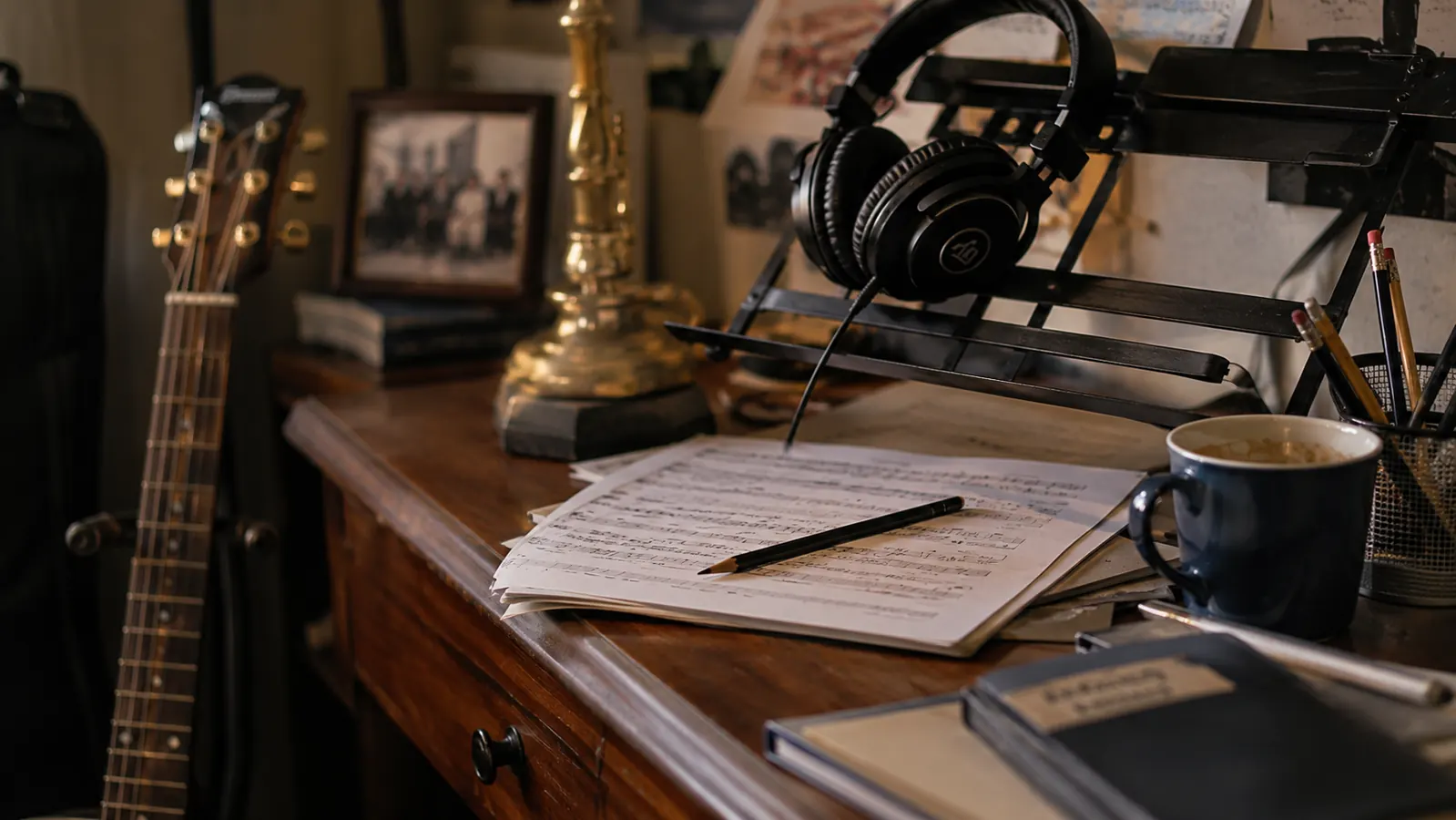
I teach music for a living, and the Audio-Technica ATH-M20x is the headphone I have bought more times than any other piece of gear in my studio. Right now there are four pairs in the building, one on my desk for checking student recordings and three in a drawer for lessons, and living with four of the same thing for two years is the closest hobbyists get to a real durability test. It is the best-selling budget studio monitor headphone on Amazon, with more than 27,000 ratings and a four-and-a-half-star average, and both numbers are earned. It is also a modest headphone with three real weaknesses that the star ratings quietly bury, and this review is about those three.
Let me be honest about which review this is. I wrote the long-term piece on the ATH-M20x for this site, the one that covers two years of daily use in lessons, recording, and my own practice, and it reads the way you would expect from someone who buys them four at a time. This article is the other half of the conversation, the one musicians have after the honeymoon, about the parts of the headphone the product bullets never mention. I am not trying to talk you out of it. I am trying to get you to buy it with your eyes open, the same way I would hand any piece of gear to a student in my studio.
The Quick Verdict
The right buy for practice, lesson monitoring, and silent home playing if you accept three truths: the tuning is colored, the band is thin, and the cable does not come off.
Amazon Check Today's Price →The Headphone the Star Ratings Bury
The ATH-M20x did more practice duty in my studio last year than any other headphone I own. That is the recommendation that matters. Check today's price on Amazon, then read the three weaknesses below so you buy them with your eyes open.
Amazon Check Today's Price on Amazon →How I've Used It
My use is not glamorous, and that is exactly the point. Four pairs, two years, and an unfriendly routine: headphones dropped on a hardwood floor by a seven-year-old who thought one was a frisbee, yanked off a head by the cable, passed to a new student every 45 minutes on group lesson nights, shut into a drawer with music stands and metronomes. One pair in that rotation sees more handling in a month than most hobbyists give a headphone in five years, which makes it a good proxy for how a first pair will survive a young musician's backpack.
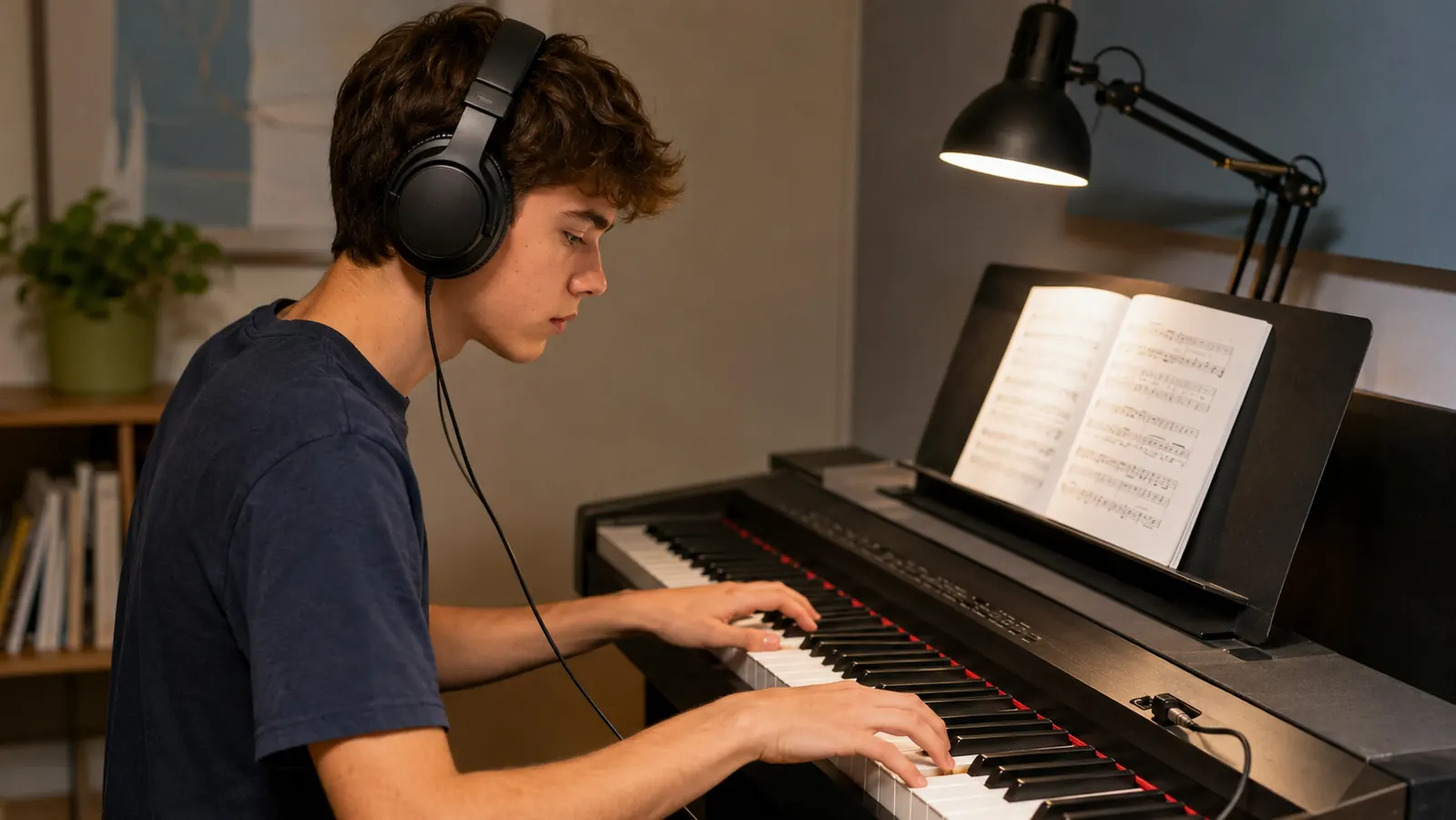
For the new buyer here is the spec sheet that matters. The ATH-M20x is a closed-back, over-ear monitor with 40 mm drivers and a stated frequency range from 15 to 20,000 hertz. At 47 ohms it plays plenty loud from a laptop, an audio interface, or a keyboard headphone jack with nothing in between. My students plug them into digital pianos at night to practice without waking the house, into interfaces to hear their own playing back, and into their phones to listen to the lesson recording I send after class. For that exact job list, the M20x is close to ideal, which is why I keep restocking the drawer.
A week with the drawer looks a specific way. Monday it is a twelve-year-old on acoustic guitar working through a strumming pattern with the M20x plugged into a pocket practice amp, and nobody in the next room hears a thing. Wednesday the pair moves to the keys studio for scale practice on a digital piano. Saturday it rides in a gig bag to a rehearsal room and comes back faintly scented with basement air. One pair does all of that in the same week without wobbling, which is a stronger endorsement than any frequency graph I could paste here.
But using something every single day is how you find out what is wrong with it, and two years of that use has given me a short, specific list. Three weaknesses, all real, none fatal. Here they are.
Weakness One: The Midrange Sits in the Back
The M20x is tuned for listening pleasure, not for the flat, neutral response that the word monitor promises. The low end gets a friendly boost and the top end a sparkle, so recordings sound exciting on first listen. The bill for that excitement is the middle: vocals, the body of an acoustic guitar, the meat of a piano part, all of it politely steps backward in the mix. Put the M20x next to the flatter M40x or M50x on the same track and you hear two things: the M20x is not bad, and it still draws a smiley-face curve over the music that hides the detail you need when you are trying to improve.
For a young student this cuts both ways, and I tell every family about it. The bump makes the student's own playing sound better than it is, a gift for confidence and a lie for accuracy. When I record scales and sit a student down to listen back, the M20x makes the good notes sound great and the missed notes sound fine, which is lovely for morale and useless for fixing what needs fixing. If you want to hear yourself the way an engineer hears you, this is not that headphone. If you want to enjoy practicing, it is exactly that headphone. Knowing which of the two you are buying is the whole honest review in one sentence.
There is a partial fix for the tuning, and it is worth knowing before you blame the headphone. Inside a recording app or a digital audio workstation you can take a little weight off the low bass and lift the dip around the upper mids with a couple of fader moves, and the M20x behaves noticeably closer to neutral. The catch is that most students practice through a digital piano or a phone, where there is no equalizer to reach for, so the curve is what it is in the places the M20x actually lives. Learn to work with the sound instead of fighting it.
Weakness Two: The Band on Top
The headband is the weakest physical part on the whole product. The padding under the band is thin, and the frame is plastic that creaks when you flex it in your hands. After a rough year of student use, the leather-look covering on the ear pads starts to flake around the edges, cosmetic wear that never shows up in a product photo but shows up the first time you look closely at your own pair. This is the plain truth about a headphone at this price: something had to be the budget line, and a lot of that budget landed here.
The clamping force is also real and worth knowing about before the box arrives. Fresh out of the box the M20x grips a head like a nervous parent gripping a toddler's hand, and for the first week or two of daily use you feel it around the forty-minute mark. The plastic relaxes as it is worn, and after a month the fit is snug without being a vise. If you sit down for four-hour mixing sessions, the step-up models with deeper, softer pads are worth the distance. If you practice in twenty-to-forty-five-minute blocks the way most of my students do, the band is a footnote, not a reason to walk away.
Weakness Three: The Cable That Chooses You
The cable is attached, and it stays attached. The M20x does not let you unplug the cord, and that single fact is the number one reason pairs leave active service in my drawer. Kids do not treat cables gently. They wrap them tight, they close drawers on them, they swing headphones by the wire. When a cable dies on a headphone that takes a replaceable cord, you spend a few dollars and keep the cans. When the cable dies on the M20x, you buy a whole new headphone, because opening the housing to splice a wire on a modest pair is not a repair anyone does twice.
So the workaround is boring but true: take care of the cord. Unplug at the jack when you are done, coil the cable loosely, never yank a student's headphone off their head by the wire, and the cable will outlive the pads. Audio-Technica reserves the detachable-cable design for the M40x and M50x, and that is part of what the higher price buys. For classroom and practice duty, the fixed cable is a manageable flaw if you treat it like one instead of pretending it is not there.
The midrange is where the truth lives when you practice, and the M20x softly blurs it. That is the honest trade at this price: a friendlier sound for a less exact one.
What It Still Does Better Than Almost Anything at This Price
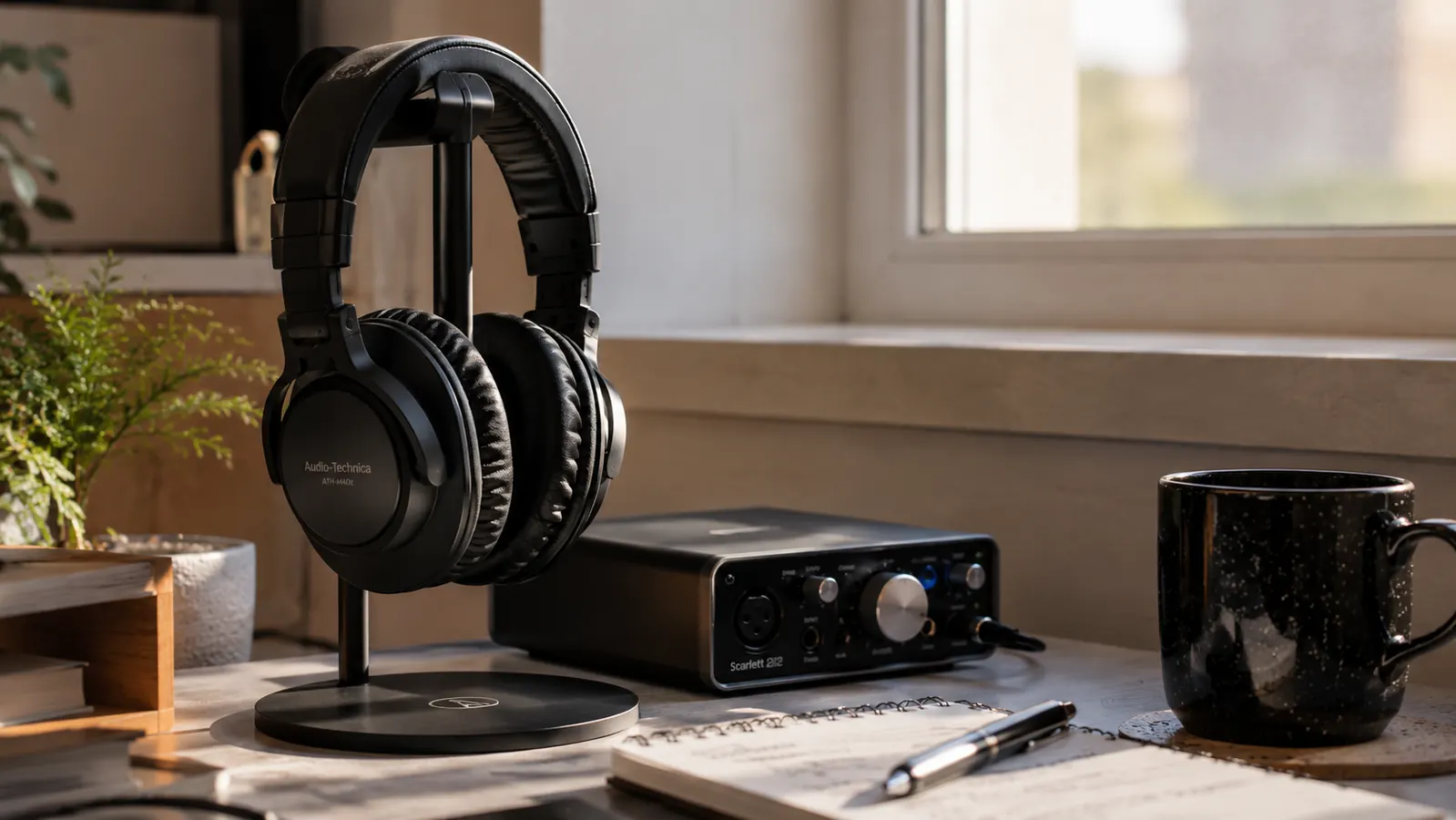
After all three weaknesses, the honest summary should not surprise anyone who has read this far: I still buy them by the set. The M20x seals out the room well enough for a student to practice beside a sleeping sibling, plays loudly from anything with a headphone jack, folds flat enough for a gig bag, and accepts the daily shove into a drawer without complaint. Isolation is not studio-grade, but for a home practice room it is more than enough, and the closed-back design is the entire point for anyone practicing in a house full of other people.
The sound is also genuinely fun to practice with, and I have stopped being shy about that opinion. I would rather a first-time student hear their own playing through the M20x than through a flat reference can, because the headphone flatters the very moments when curiosity is everything and progress feels good. You can buy a more accurate monitor later, when your ear has caught up to the difference and you are recording instead of learning. Buying the M20x first is the right order, not the wrong one.
The value question is the one worth closing on. A young musician who needs a closed-back pair for practice can spend a good deal more and get a flatter, more comfortable headphone, and a family that has not developed the ear yet will not hear the difference. What the M20x gets right is the arithmetic: it does the only job a student's headphone really has, which is to make practice possible after dark and to keep the student sitting at the instrument. Spending more up front does not make a beginner practice longer, and that realization is the reason the drawer gets restocked in threes.
Alternatives I Considered Before Recommending
The obvious comparison is the ATH-M30x, the next step up in the same Audio-Technica family, and it is the pair I hand a student who plans to record rather than just practice. The tuning is flatter, the pads are more comfortable, and the build feels more willing to live a long life. It also costs more, and for silent practice and lesson playback that extra does not always pay for itself. The two sit side by side in the M20x vs M30x comparison article on this site, with every difference laid out row by row.
The other name that always comes up in this price class is the Sony MDR-7506, a studio workhorse for decades. I own a pair and love it, and it tells the truth about vocals and detail more plainly than the M20x does. It is also brighter in the highs, and my students find the M20x easier to live with across a long practice session. For teaching and home practice I keep coming back to the M20x because it is comfortable to ignore, and for a beginner, the headphone you stop noticing is the one you keep using.
The M50x is the famous cousin everyone searches for, the pair you see on every recording desk in every video, and it is a lovely monitor: flatter, with a detachable cable and a better build. It is also two to three times the money, and I do not hand it to students for the same reason I do not hand a beginner a boutique amplifier: the expensive pair does not make the practice week easier, it just survives it better. Between the two, the M30x remains the honest middle step for anyone who plans to record.
What I Liked
- Friendly low end and sparkling highs make daily practice genuinely enjoyable
- Closed-back isolation for silent practice in a shared house
- 47-ohm impedance plays loud from laptops, interfaces, and keyboards
- Folds flat and survives years of rough student handling
- Undisputed value at the budget end of the monitoring scale
Where It Falls Short
- Colored midrange hides the detail you need for accurate self-criticism
- Thin headband pad and ear-pad leather that flakes after a rough year
- Non-replaceable cable means a dead cord ends the headphone
- Clamping force is strong for the first weeks out of the box
- Plastic frame creaks and flexes more than the step-up models
Who This Is For
The M20x is for the young musician practicing in a house with other people, for the adult restarting an instrument who wants to play at midnight without waking anyone, and for the parent who needs one good pair of headphones that will survive a backpack and a school year. It is for anyone who wants a closed-back, comfortable, loud-enough headphone for daily practice on a realistic budget, doing that one job for years without drama. The reason I trust it with students is simple: when a pair disappears into a backpack for a semester and comes back still sounding right, that is more than I can say for pricier pairs I have lent out. If you want the full silent-practice setup, from the headphone jack on a digital piano to an audio interface, my step-by-step guide on this site walks the whole rig through.
Who Should Skip It
Skip the M20x if you mix or master audio for money, because the smiley-face tuning will quietly lie to you about your lows and your highs. Skip it if you regularly wear headphones for four-hour stretches, because the clamp and the thin pads will wear on you. Skip it if you are hard on cables and unwilling to treat this one gently, because the fixed cord means the cable decides the lifespan. And skip it if you want the flatter, more honest sound of the M30x and can pay the difference. For everyone else, buy it, enjoy it, and know exactly what you got. If none of those descriptions fit you, there is a good chance the M20x becomes the pair you reach for every day, flaws and all, exactly the way the drawer in my studio works.
The Headphone I Buy Four at a Time
A friendly sound, a closed back, and everyday durability at a price a family can afford without flinching. For practice, the M20x is the pair I hand students. Check today's price on Amazon.
Amazon Check Today's Price on Amazon →