
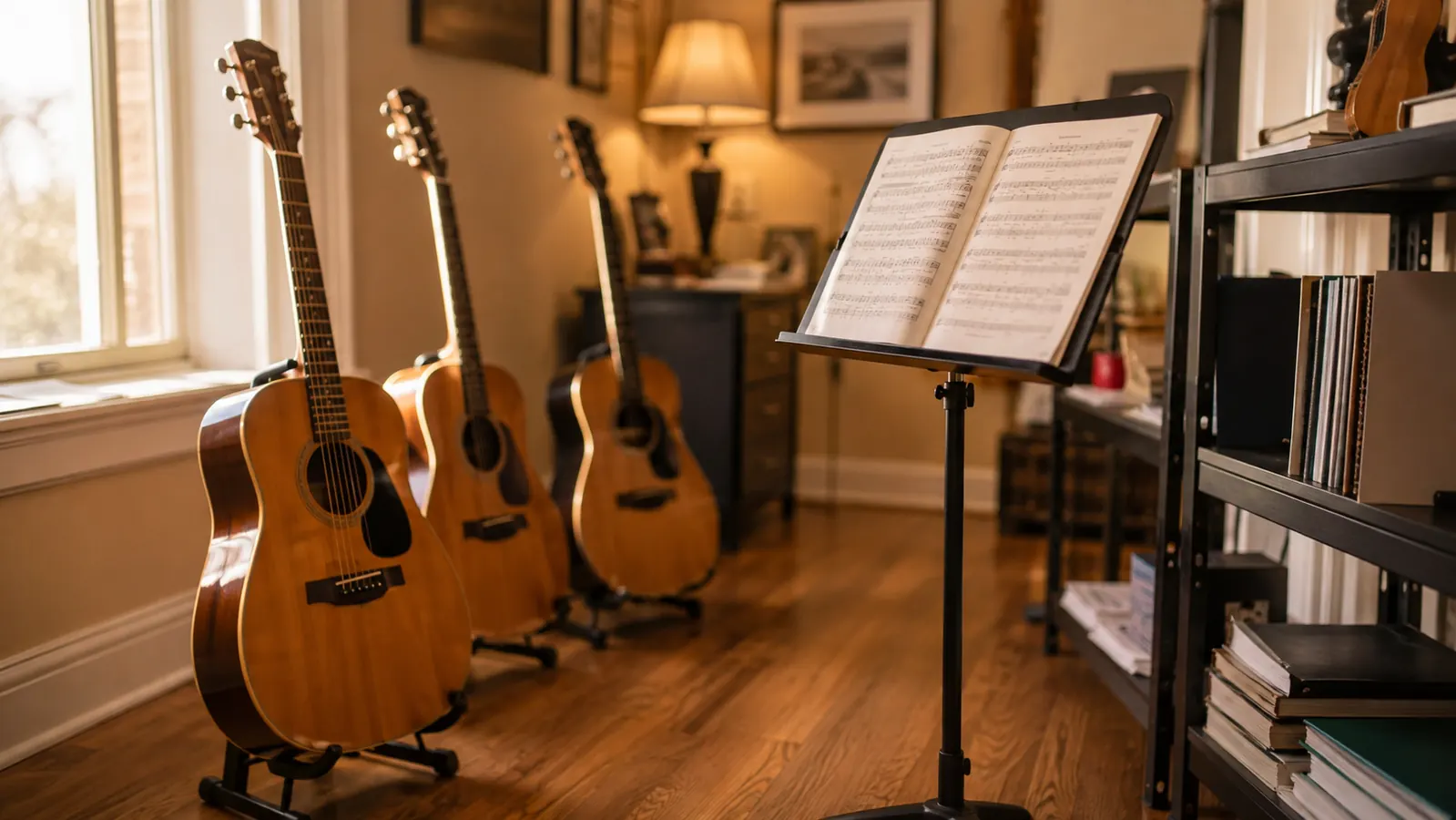
I did not notice what a good clip-on tuner does for a teaching studio until I stopped having to think about tuning at all. For my first few years of teaching, tuning owned the first ten minutes of every lesson. Students came in with instruments that had sat in cases all week, half a step down at best, and I worked the room with a handheld tuner while the kids waited. I bought the first Snark SN-8 on a whim in early 2024, mostly because it was cheap and the clip looked handy. Two years and seven tuners later, it is the one piece of gear I recommend to every parent before I recommend an instrument.
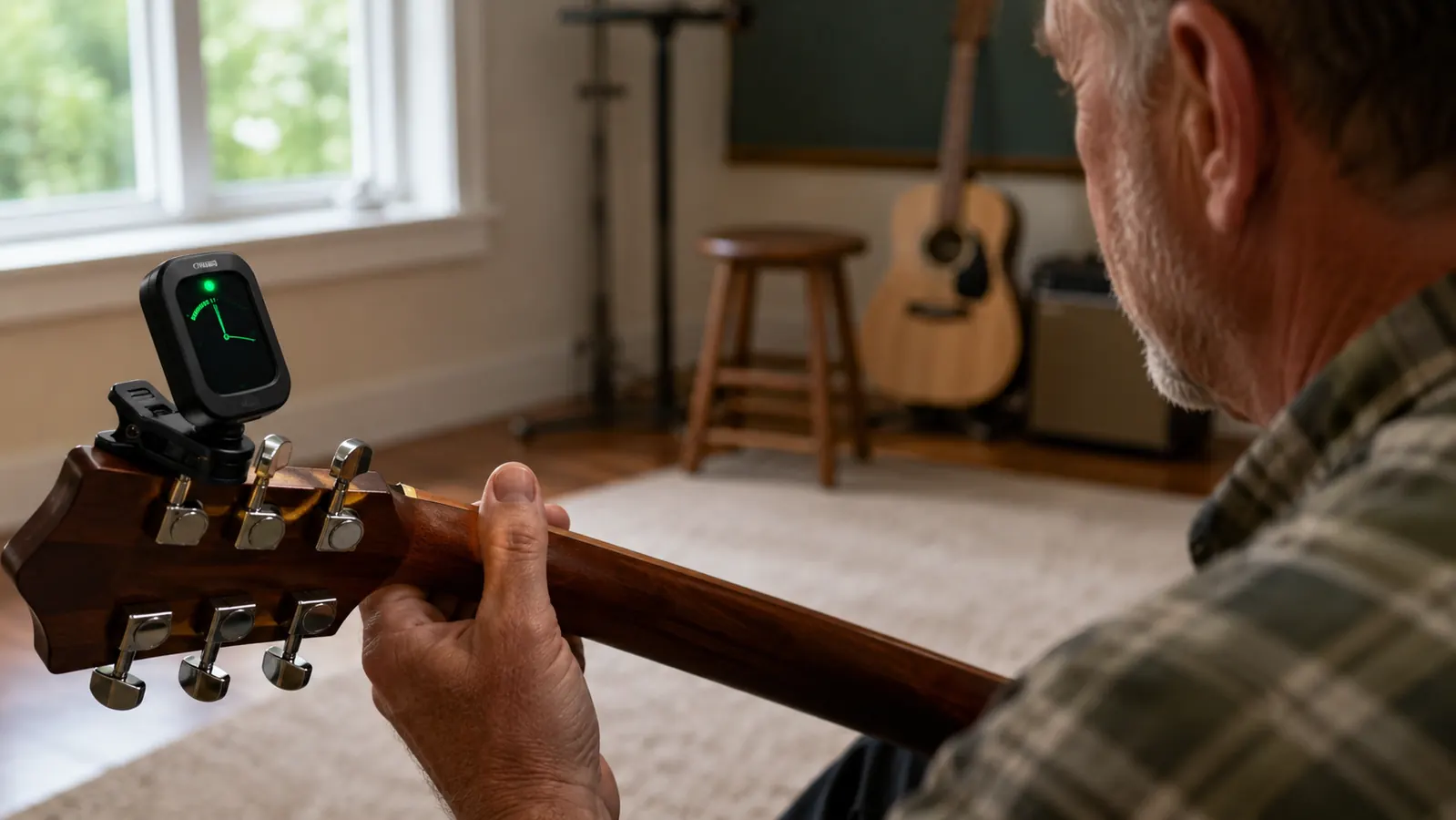
Here is what the product page manages to undersell. The SN-8 is a vibration tuner, not a microphone tuner. You clip it to the headstock of a guitar, the scroll of a violin, the bridge of a ukulele, and it reads the wood, not the air. That single detail is the whole story in a teaching studio. Phone apps hear everything. The SN-8 hears only the instrument it is touching, which means it works while six kids tune at once, a metronome clicks, and the space heater rattles.
The Quick Verdict
The clip-on tuner I buy for every student. Two years of daily use and I have not found anything faster or more foolproof.
Amazon Check Today's Price →A tuner that ends the tuning chore before the lesson starts
The SN-8 is the first thing I hand to a new student's parents. Two years of daily use, hundreds of student instruments a week, still fast and still accurate. See today's price on Amazon and why music teachers keep a drawer of them.
Amazon Check Today's Price on Amazon →How I've Used It
My week is predictable. Monday through Thursday I teach private and group lessons, and weekends I play in a cover band with an acoustic, a couple of electric guitars, and a bass. The SN-8 lives in three places: one in my gig bag, one in my desk drawer, and one clipped to the music stand in Room 2 where we do group guitar. I have used it on acoustic and electric guitars, two classical guitars, a violin, a viola, a ukulele, a mandolin, and once on a student's cello that came out of a closet after a year.
The different instruments behave differently under the clip, and that is worth knowing before you hand one to a student. On a violin you clip to the scroll and the tuner reads instantly, but the whole pegbox is small enough that I set the tuner to the side so it never gets in the way of a bowing arm. On a mandolin the headstock is so narrow that the SN-8 overhangs the edge, and it still reads perfectly, which surprised me the first time. On a small ukulele the clip goes over the headstock sideways and the auto-rotating display makes it readable without a second thought. The bass is the one picky instrument: a floppy low E string reads as a wobble at first, so you pluck the low end a little harder and give the needle a beat to settle. None of this is a complaint. It is the difference between reading the wood and reading the air, and knowing which instrument wants a firmer pluck.
Why the SN-8 Reads Faster Than the Alternatives
The SN-8 has modes for guitar, bass, violin, ukulele, and chromatic, plus a calibration range that runs from 415 to 466 Hz. Most students never leave guitar mode, and they do not need to. The tuner remembers the last mode it was in, so a kid who tunes in guitar mode every week never touches a button. It opens in the right setting, clips where he always clips it, and the needle settles inside a second.
The accuracy is the part you only appreciate when you stop double-checking it. I use an SN-8 to set the intonation on my own guitars, and my own guitars stay in tune up the neck. When I have put a strobe tuner on the same bridge to verify, the strobe agreed with what the clip already said. For about the cost of a single lesson, that kind of dependability is serious value. A Snark will never win a feature-counting contest, and that plainness is exactly why it never stops working.
What Vibration Sensing Hears That Phone Apps Don't
The closest thing the SN-8 has to a rival is not another tuner. It is the tuning app already sitting on every family's phone, so I owe you an honest comparison. A phone tuner runs on the microphone, which means it hears everything in the room: the air conditioner, the metronome, the kid two chairs over, the band room down the hall. In a quiet bedroom that is fine. In my group class on a Tuesday night, an app needle swims and never settles, because it is trying to follow a dozen sounds at once. The clip reads only the instrument it touches, and it settles in under a second no matter how loud the room gets.
I have run this test side by side more times than I can count. With the SN-8 on the headstock and a phone on the stand next to it, I pluck the same string while someone claps. The app jumps, travels, and takes a moment to land; the clip barely moves. When both settle, they usually agree within a cent or two, which is the part that tells you the accuracy is real and not just a spec sheet promise. But accuracy was never the only reason to choose. The phone app needs the student's hand, the student's attention, and usually one more unlock before it works. The clip is already on the instrument. For a teacher, that difference is the whole point.
I have not started a lesson late because of tuning since the first week the SN-8 was in my studio, and I could not say that about any year before it.
Two Years of Daily Use: What Wears, What Doesn't
The honest part first. The SN-8 is plastic on plastic, and the clip is the weak point. After about eighteen months of daily clip-on, clip-off, the swivel on my desk unit got loose enough that the display droops when the tuner hangs sideways on a headstock. It still reads perfectly. It just will not hold the angle it used to. The clip spring is the second thing to soften, on the oldest unit, after a student dropped a whole guitar with the tuner attached. The tuner survived the drop. The clip is a little rattly now.
Everything else has proven genuinely tough. I have dropped the desk unit on a wood floor, knocked it off a music stand, left it in a gig bag under a stack of sheet music, and watched a ten-year-old swing a violin with the tuner still clipped on. The drop list is longer than that, honestly. Bags get shoved onto instrument cases, tuners bounce onto parking-lot asphalt between the car and the lesson, and the tumbled ones read exactly like the ones that never left the desk. We lose more SN-8s to the bottom of a pocket than to breakage, and every one of the ones we have found again has turned right back on.
Battery Life: The One Thing I Never Think About
Battery behavior deserves its own section because it is the least obvious thing about the SN-8 and the thing families ask me about most. A single CR2032 coin cell lasts about a year in my desk unit, which gets clipped on and off across a hundred student instruments a week, and the unit in my gig bag stretches close to two years because it gets used in bursts. You know a cell is going the same way every time: the display starts dimming, the readout gets faint on bright days, and then it stops holding a reading. There is no warning beep and no battery meter. You learn the one visual signal, and you keep a spare cell in the desk drawer.
My practical tip is to check the tuner before the first lesson of a new season. A tuner that has sat in a closed case since spring very often comes out in the fall with a dead cell, and I have watched entire families conclude that the tuner broke when the display was merely dim. Ninety seconds with a fresh cell and the very same tuner reads perfectly again. In a world of rechargeable gear that wants a cable and an hour of attention, a tuner that runs eleven or twelve months on a coin cell is the most reliable piece of electronics in my studio, and it is exactly why I keep buying Snark instead of anything with a charging port and a companion app.
Cold Rooms, Frozen Hands, and Winter Tuning
Winter is where the SN-8 earns its keep in my studio more than any other season. Cold instruments slip out of tune fast, and guitars that live in unheated rooms and garages come in on a January afternoon half a step flat, taking the first part of the lesson just to warm up. With the clip on, I can watch that drift happen in real time on the display, and I can show a student why a cold instrument will not hold pitch until the wood has had time to settle. That lesson lands because they see the needle fall in front of them, not because I have recited the same warning at the start of every winter since 2018.
The tuner itself handles the cold without complaint. The LCD is a little slower to full contrast when the whole studio has been cold all night, and it wants a few seconds to wake up on a 40-degree morning, but once it is awake it is the same steady readout it is the rest of the year. What I keep in the drawer before December is a fresh spare cell, because a winter gig in a cold parking lot with a dim display is exactly when you do not want to discover the battery is at its end. Replace the cell before the season turns, and the cold months simply stop being a tuning problem at all.
The Teaching Trick: Tuning Before the Lesson Starts
The biggest win is not tuning faster during the lesson. It is that the tuning happens before the lesson starts. Every student who owns an SN-8 tunes at home the night before, because it takes ninety seconds and the tuner lives in the case. Parents tell me the same thing in different words: the tuner is what got their kid to pick the instrument up on a Thursday evening. An instrument that sounds right the moment you touch it makes a kid play longer.
In the group classes, my rule is that the tuner stays clipped on during warm-up. When a string goes flat mid-lesson, which happens to beginners constantly because they press too hard, the display shows it right away and we fix it in ten seconds instead of the string sounding wrong for the rest of the song. That small change made the whole class sound better, and it taught the kids exactly what an out-of-tune string sounds like before it sounds like a mistake.
The clearest proof came from a young student whose guitar had arrived out of tune for months, because no one at home could hear that the strings were wrong. Her family bought an SN-8 after the third time I asked, and two weeks later she walked in with strings that were balanced before the first chord. Nothing about my teaching changed. What changed is that someone in the house can now see what I hear, and tuning became a five-minute job anyone can check instead of a problem only I understood. That is what happens when a family owns one: the instrument gets tuned on a Thursday evening, and Thursday evening is exactly when it needs it.
Where the SN-8 Shows Its Age
For all the good, there are three things I tell people before they buy one. First, the display is small and it has a preferred angle. The auto-rotate helps, but in bright daylight, on a porch or at a park, you will cup a hand around it to see the needle. Second, the built-in microphone is a backup, not a feature. Clip the tuner to a stand or a music rest instead of the instrument and it gets confused in a noisy room, because it tries to decide between the instrument you care about and your neighbor's.
Third is the flat-tuning dance. There is no dedicated flat mode for players who tune down a half step. You hold the calibration button and step the pitch reference down from 440, and it works, but a student who plays in Eb will end up somewhere confusing unless I set it for her myself. It is a minor friction, not a reason to skip the tuner, but it is real and worth knowing before you buy.
What I Liked
- Reads vibration, not air, so it keeps working in a noisy classroom or band room
- Display auto-rotates, so the readout is never upside down on a headstock
- Fits every instrument I teach: guitar, violin, viola, ukulele, bass, mandolin
- A single CR2032 cell lasts about a year of daily use before the display dims
- Low enough in cost that I recommend one per student, not one per family
Where It Falls Short
- Clip spring and swivel wear down after roughly eighteen months of daily use
- Small display washes out in direct sunlight
- Stepping the pitch reference down for flat tunings confuses new players
- The built-in mic is a backup; clip it to music-stand metal and it reads the room
Who This Is For
The Snark SN-8 is for anyone who will actually clip it on, which is a wider group than you would think. It is the first purchase I recommend for a new student's family, above picks and above a stand. It is for the bedroom guitarist whose tuner app keeps dying mid-tuning. It is for the violin teacher, the ukulele club, and the parent whose kid is in a school band and needs to walk into rehearsal in tune. If you own one instrument, you want one. If you teach, you want a drawer of them.
Who Should Skip It
Skip it if you only ever tune one instrument at a desk and never leave the room, because the phone app you already have is probably fine. Skip it if you want a tuner you can read from across the stage, because the SN-8 is not that. And before you commit, read the honest review on this site for the full story on durability, because the clip is exactly where these tuners eventually give out. I keep recommending the SN-8 anyway, because nothing else gets a room full of student instruments in tune faster. If you want my exact tuning routine, the step-by-step guide covers it.
The tuner that earns its spot in every gig bag
Two years of daily use in my studio and the SN-8 is still the first thing I hand to a new student's family. Whether you are buying your first instrument or tuning a roomful of them, this is the tuner. Check today's price on Amazon.
Amazon Check Today's Price on Amazon →